Training & workshops
Training and team reflection.
A better grasp of tension.
One session cannot change a culture. But the right session can be a turning point.
Book an introductory callPolarisation: recognise, interpret and act
Recognise when differences turn into us-versus-them thinking. Understand the dynamics and learn to act without fuelling them.
Explore the courseThe Cohesion Field in practice
See the people, roles and stories that hold things together. Build trust and strengthen the middle.
Explore the courseContext-sensitive action
Stay grounded when a conversation shifts. Learn to read the context, adapt thoughtfully and respond appropriately.
Explore the courseDe Dilemmawissel
Explore unspoken dilemmas, understand colleagues’ perspectives and agree on practical improvements. A facilitated workshop for teams.
Explore the workshopCombined offer
See what drives people apart.
And what still holds them together.
Polarisation and Het Cohesieveld complement each other. Together they provide a fuller picture of both tension and the strengths you can build on.
The polarisation lens helps you recognise growing us-versus-them thinking, hardening positions and pressure on trust. Het Cohesieveld also draws attention to the people, relationships, narratives and practices that continue to sustain connection.
This combination prevents the problem from becoming the only focus. It also reveals where movement is possible and which next step is most promising.
- As a workshop or training course for teams and professionals
- As a presentation or keynote for an event or conference
- As a stand-alone session or part of an extended learning pathway
01 / See
Polarisation: recognise, interpret and act
Recognise when differences turn into us-versus-them thinking. Understand the dynamics and learn to act without fuelling them.
What you take away
- Distinguish between conflict and polarisation
- Recognise both horizontal and vertical polarisation
- Understand roles, underlying dynamics and your own position
- Communicate without unnecessarily fuelling tension
Who is it for?
Professionals in local government, neighbourhood teams, education, social services, youth work, policing and HR; managers and policy officers.
Read the full course description
When us-versus-them thinking grows, you need to recognise what you are seeing Polarisation rarely begins with shouting. It often starts earlier, more subtly and more quietly. A group withdraws. A remark lingers. People stop asking questions and start making assumptions about each other. Cynicism grows. A team no longer speaks openly. Residents say: “You never listen anyway.” Or professionals sense a shift but cannot yet identify exactly what is happening.
In this course, participants learn to recognise polarisation before it escalates. They learn to distinguish between conflict and polarisation, which are often confused. A conflict usually has a specific issue, time, place and people involved. Polarisation goes deeper. The conversation shifts from substance to identity. It is no longer just about what someone thinks, but about who they are, which group they belong to and which side they are expected to choose.
The course gives participants a language for understanding these dynamics. We examine horizontal polarisation between groups, as well as vertical polarisation between citizens and institutions, residents and government, employees and management, students and schools, or communities and systems. This vertical dimension is often underestimated, yet it can involve deep distrust, old wounds and a lack of recognition. Participants explore the roles that emerge in a polarised setting. Who adds fuel? Who joins in? Who stays silent? Who tries to build bridges? Who becomes a scapegoat? And, perhaps most importantly, which role is assigned to you as a professional, even if you did not choose it?
This course is for professionals who work daily with tension, differences and distrust. This includes local government professionals, neighbourhood teams, education, social services, youth work, police, HR, managers, policy officers and civil society organisations. It also suits teams that need a richer shared language to understand what is happening in their environment or organisation.
Participants leave with a shared conceptual framework. They can better distinguish what they see, what lies beneath the surface and which intervention makes sense at which moment. They learn to communicate without unnecessarily adding fuel and to choose their position more consciously without becoming trapped in the dynamics. The result is greater calm, clarity and capacity to act in situations that can quickly harden. The course is available as a half-day or full-day session for approximately 8 to 25 participants. It can be delivered in person or online, always interactively, grounded in practice and connected to participants' real situations.
02 / Sustain
The Cohesion Field in practice
See the people, roles and stories that hold things together. Build trust and strengthen the middle.
What you take away
- Use the Cohesiekaart to identify Connectors, Recognisers, Narrative Builders and Quiet Supporters
- See who sustains the social fabric
- Apply the five principles of cohesion
- Strengthen trust and collective resilience in your own practice
Who is it for?
Public leaders, managers, policymakers, teams and professionals who want to build trust and connection over time.
Read the full course description
If you only look at what is breaking down, you miss who is holding things together Many organisations view social tension through the lens of risk, conflict or damage. That is understandable, especially under pressure. But focusing only on what is breaking down often means overlooking the people, places, stories and practices that still hold things together. That is the starting point for this course.
The Cohesion Field is my approach to making social cohesion visible, discussable and possible to strengthen. It offers a practical lens for seeing what still sustains a team, organisation, neighbourhood, school or community. In every context, people maintain relationships, sense tension early, create meaning or bring calm. They are often crucial yet overlooked, because attention tends to focus on the loudest voices, incidents or formal structures.
In this course, participants use the Cohesiekaart, which I developed. They map who sustains cohesion in their own context: Connectors, Recognisers, Narrative Builders and Quiet Supporters. They explore what they want to protect, draw on the five principles of cohesion and formulate a first intervention or next step.
Participants learn to work with the four roles of the Cohesion Field: Connectors, Recognisers, Narrative Builders and Quiet Supporters. These are forces that can be present in any organisation or community, rather than job titles. Connectors keep contact possible when relationships become strained. Recognisers give words to pain, discomfort, hope and aspiration. Narrative Builders create stories that offer direction and prevent an us-versus-them narrative from dominating. Quiet Supporters provide calm, continuity and shared social expectations, often without recognition. We also work with the five principles of cohesion. Relationships come before content. Recognition precedes change. Symbolism shapes meaning. Cohesion grows through practice. Making space is relational work. These principles help participants understand what a situation needs relationally before jumping to solutions.
The course is for public leaders, managers, policymakers, teams and professionals who want to go beyond reacting to tension and build trust, connection and collective resilience over time. It is particularly suited to municipalities and organisations working in highly diverse settings, where standard policy does not always resonate and different groups view the same situation through different realities.
This course makes social cohesion tangible. Participants learn to see who or what sustains the social fabric, where connection is under pressure and which interventions can strengthen trust. The focus is on daily practices that help people stay in relationship despite their differences.
Participants leave with a clear framework for recognising and strengthening cohesion in their own practice. They can better identify which roles are needed, which stories are missing, which quiet forces deserve protection and where an organisation or community can begin building greater resilience. The course is available as a half-day or full-day session for approximately 8 to 30 participants, in person or online. Both formats use relatable examples, reflection on participants' own contexts and practical application.
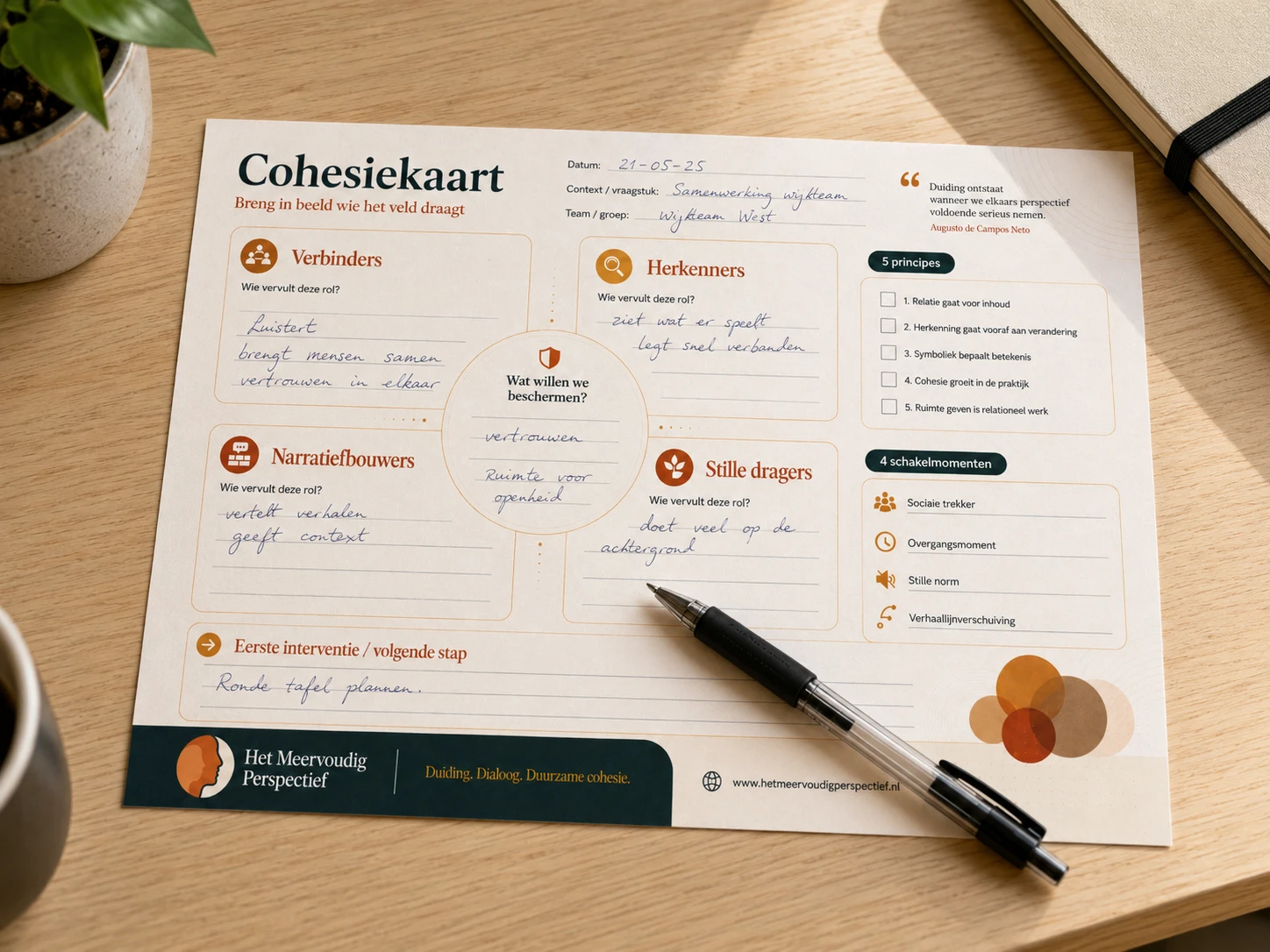
The tool used in this course
From the Cohesion Field
to the Cohesiekaart.
In this course, participants use the Cohesiekaart, which I developed. They map who sustains cohesion in their own context: Connectors, Recognisers, Narrative Builders and Quiet Supporters. They explore what they want to protect, draw on the five principles of cohesion and formulate a first intervention or next step.
The map also draws attention to four moments of change: a social trigger, a transition, an unspoken norm and a shift in the narrative.
The central question: what do we want to protect? The outcome is a concrete first step in your own practice.
03 / Act
Context-sensitive action
Using the ContextKompas, which I developed, you move through six steps from an initial judgement to a considered next step. Learn to read the context, adapt thoughtfully and respond appropriately.
What you take away
- Observe, interpret and adapt in the moment
- Recognise your own reflexes: appeasing, solving, defending or avoiding
- Use the ContextKompas to gain confidence in complex situations
- Slow down, set boundaries or ask further questions when needed
Who is it for?
Trainers, facilitators, advisers, teachers, neighbourhood professionals, civil servants, HR professionals and managers.
Read the full course description
Because no situation goes exactly to plan Professionals increasingly face situations where the script does not work. A meeting takes an unexpected turn. A conversation shifts. A participant becomes emotional. A group distrusts the organisation before anyone has spoken. The professional's formal role no longer fits what the situation needs. Or a carefully prepared programme turns out to miss what is really happening in the room.
At that point, you need more than policy, protocols or ground rules. You need the ability to act sensitively to the context. Context-sensitive action means being able to observe, interpret and adapt in the moment, rather than simply following your intuition. You learn to read what is happening in the room, in language, body language, silence and relationships. You learn when to slow down, set boundaries, ask further questions or briefly do nothing. This course focuses on professional practice in complex situations. Participants learn to hold multiple perspectives without losing their footing. They examine their own reflexes: do I explain, appease, solve, defend, avoid or confront too quickly? And what does the situation actually need from me, beyond my automatic response?
We work with situations from your own professional practice. Using the ContextKompas, which I developed, you move through six steps from an initial judgement to a considered next step. The facilitated exercises help you stay grounded, understand what the situation needs and respond with greater awareness. The course is for professionals who need to act when standard answers fall short.
Participants leave better able to stay grounded when tension, emotion and uncertainty come together. They are better equipped to read the situation, maintain their own position and act without oversimplifying it. They learn to handle complex situations as well as discuss them. The course is available as a half-day or full-day session for approximately 8 to 20 participants, in person or online. It works best when there is sufficient space to practise with real situations.
The tool used in this course
The ContextKompas.
Developed by Augusto de Campos Neto
Six steps from an initial judgement to a considered next step.
Gain confidence when a conversation shifts or tension rises. During the course, you work with the tool under my guidance, using situations from your own practice.
The ContextKompas is a tool for reflection and action, not a diagnosis or a definitive explanation of behaviour. Check assumptions with those involved and take professional responsibilities, safety and applicable rules into account.
Workshop · Team reflection
De Dilemmawissel
What are colleagues experiencing that stays unspoken?
The same meeting can feel open to one person and leave another feeling unheard. An initial explanation rarely tells the whole story. How can a team make room for experiences it does not yet understand?
De Dilemmawissel is a method for exploring different perspectives, reflecting as a team and improving collaboration. In a facilitated session, colleagues explore dilemmas submitted without names and practise looking beyond their initial assumptions.
From judgement to understanding. From understanding to insight. From insight to action.
What your team works towards
- Greater understanding of colleagues’ experiences and expectations
- Awareness of assumptions that can affect collaboration
- A clearer picture of recurring concerns and underlying patterns
- Practical proposals for improving how the team works together
The conversation is a starting point.
The method moves through seven facilitated phases. The team explores possible explanations without treating them as facts. Nobody is required to identify themselves as the person who submitted a dilemma.
Follow-up is part of the agreement from the outset. The manager takes responsibility for discussing feasible actions with the team and reporting back on progress. We agree in advance how the findings and follow-up will be handled.
When might it help?
For teams seeking to strengthen trust, communication and collaboration, including during change or when concerns are not easily voiced. A major conflict does not have to have occurred.
We first discuss the team’s context, confidentiality and whether a group session is appropriate. Serious conflict or unsafe relationships may require a different approach.
Always tailored
Your practice is the starting point.
What prompted the request? Who are the participants? Which tensions are visible, and what remains unspoken? What needs to be different afterwards?
I adapt the content, examples, exercises and tone to your situation. Where useful, this includes an intake with participants or a follow-up conversation to help learning take root in everyday practice.
A clear story that kept me engaged.
Anonymous participant · Polarisation, 17 September 2026 · translated excerpt
View the training overview ↗The first step
Tell me what is happening.
A 30-minute call, with no obligation. Together, we explore what your situation needs.
Registerplein-certified Polarisation workshop
Polarisation training: 8.3 across 16 evaluations.
The average of all 16 ratings from two training sessions in 2026. Both evaluations used a rating scale of 4–10. This score relates to these sessions.
| Session | Responses | Average |
|---|---|---|
| Utrecht · 12 May 2026 | 7 | 7.9 |
| Amsterdam · 17 September 2026 | 9 | 8.6 |
“The combination of theory and practical examples.”
Anonymous participant · Utrecht, 12 May 2026 · translated
“Tools for conversations, a clear framework for thinking”
Anonymous participant · Amsterdam, 17 September 2026 · translated